The Backcard Vault
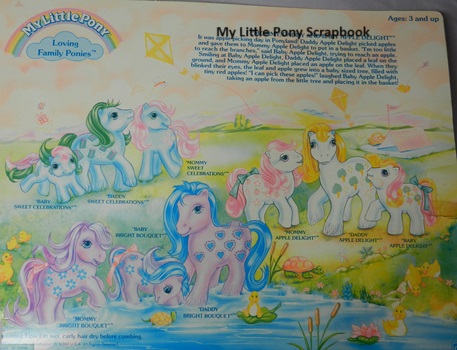
The Loving Family Pony Gift Set
| search engine by freefind | advanced |
One thing I've noticed in discussions online is that many
collectors don't know (or maybe care) about which card their
pony is on when they buy a MOC pony. This is especially common
in the UK, because of two factors. One, in most cases, American
carded ponies are more common, and two, most sites and sources
don't actually concentrate on packaging. When they do, they
mostly focus on those from North America, because, again, these
are more common.
One of the problems with this is that people also then assume
that a particular pony is common or rare irrespective of the
card they are on (or box they are in). For example, a Mint on
Card Firefly from 1984 on American card is relatively common
compared to a Mint on Card Firefly from 1985 on American card.
Both of these are more common than a Mint on Card Firefly from
either year on Canadian (bilingual card). But all of
these are more common than Italian Firefly, mint on Fable card
(in German). And, there are still more Italian Fireflies on card
in German than there are Hong Kong Fireflies on the same style
of card in English (from Scandinavia). There are even
potentially Fireflies on Danish card, although I don't even know
if one survives.
People often talk about Firefly as "common". But cards, and mint
on card ponies, cannot be judged by the rarity of the pony. They
are common or rare because of how they are packaged as well.
Packaging is it's own subcategory of collecting, and too often
it is disregarded (or even, sadly, destroyed).
On top of this is the reality that no Mint on Card ponies are
anywhere near as common as their loose counterparts. They are
finite, and in some cases, do not survive, especially in
European and UK releases. This is why decarding is something
that most collectors eschew. It is permanently damaging a
collectable item, in much the same way as hacking off a pony's
leg - once done, it cannot be undone.
The rarity question is also true for backcards, however. So
many of these were just thrown out throughout the eighties and
nineties, as just bits of card. There are several sets for which
only partial examples exist, which makes preserving those that
are left just as important as preserving the Mint on Card
examples. These are the information bases of our current and
future pony knowledge - they are tangible, while websites are
digital and prone to disappearing.
In the long run, I hope to have scanned examples of all
different kinds of backcards up in this resource, for better
comparison and information/collecting purposes. But for now,
working out the best way to achieve that is still rumbling in my
mind, so for now that part of the vault is on hiatus.