1993
Going it Alone
Birthday Pony
1993 My Little Pony Insert, UK and Europe
Birthday Pony
1993 My Little Pony Insert, UK and Europe
| search engine by freefind | advanced |
Back in 1996, the first My Little Pony ID site, Dream Valley,
championed a system of "Years", by which to catalogue My Little
Pony releases in North America. Although the system does not
represent how Hasbro promoted ponies, it became popular as a way
to organise the North American line, and is still heavily used
today.
Because the system was created artificially, there is no
equivalent system for European ponies. Hasbro sold and promoted
ponies by calendar year in all territories (including the USA),
even if those releases were staggered throughout a twelve month
period. Since most UK and European release ponies were not known
about when Dream Valley was created, there was no provision made
to include them (even if it had made sense to do so), and the
solution has generally been to put all such ponies in a
separate, "International" category - sometimes regardless of
their release year and often with no wider context.
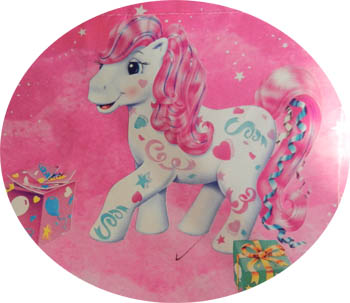
As an example of this, Bridal Beauty and the Birthday Pony
were both sold in the UK in 1993. But most sources list them as
part of "Year Ten", because they were sold in the USA in 1992.
This means that a UK collector who, as a child, might have
bought Bridal Beauty and Hairdo Starlight from the same shop
on the same day, will have to look in two completely different
parts of the site - even potentially regions - to identify them.
And, when they do find them, they will inevitably be told that
Bridal Beauty is a "US Pony" sold in the "10th Anniversary
Line", while Starlight is a "European pony" sold any time
between 1992 and 1994 (depending on sources). At worst, they
might find Starlight included in 'Nirvana' - giving them the
wrong impression of a much rarer or more valuable variation.
Some sites have tried to add a Year 11 and Year 12, but this misrepresents how ponies were sold in these non-US regions. Moreover, sites do not always agree on how to define this 'Year 11' and 'Year 12', meaning that they contradict one another, and generally get stuff wrong. This is true for the whole line - it is especially true for 1993 and 1994.
1993 was the first full year of production without the shadow
of North America in the background. The loss of this huge market
undoubtedly had an impact on production this year. All of the
poses used were old poses, from very early in the line. Unicorns
and pegasus ponies were no longer part of the concept, which was
reframed from fantasy to 'slice of life'. The central characters
in this 'world' were the Seven Characters, or Seven Pony
Assortment - better known to most collectors as the My Little
Pony Tales characters. They would take over the UK comic in its
last years, and dominate the new animated My Little Pony series,
My Little Pony Tales.
Although the Seven Characters were the dominant force this
year, however, there were also a number of other new sets that
came into play. There were new families - although
without the 'shire horse' male mould with feathered hooves, the
father ponies were now in a formerly 'female' pose. There were
also new babies and newborns released this year, as well as some
odd gimmicks. Ponies could rollerskate, and there was a
return to hair styling in the Hairdo set.
The most ambitious pony of the year was definitely Princess
Sparkle. Encrusted in glitter, with an LED light up crown,
she definitely stole the show.