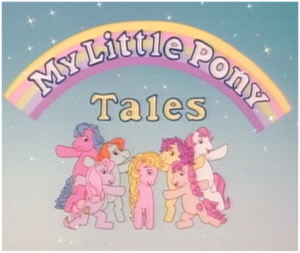
My Little Pony in the 1990s
By 1990, My Little Pony was a well-established toy on the market,
and as it shifted into the new decade, the pony releases became
more streamlined, and focused around 'sets with gimmicks', often
involving older poses. An exception to this were the Sweetheart Sister ponies, who
finally reached the UK in 1990, and whose moulds would be reused
through the decade.
As the nineties progressed, pegasus and unicorn ponies became less
common, and it was common for only four ponies from sets of six
sold in North America to make it to Europe. Where, in 1986,
Hasbro's catalogue offered stores boxes of 36 ponies per set, now
the quantity was more commonly in boxes of 12. This is not to say
that My Little Pony had dropped in popularity - just that there
were more varieties available, and choices had to be made.
My Little Pony in North America ended in 1992, after celebrating
the tenth anniversary of the line. Europe had not yet had
enough of pastel pony goodness, however, and the line continued in
the UK and on the continent (as well as in other places like
Australia) until at least 1994. By 1995, though, even Europe had
mostly ended production of My Little Pony. Only a handful of new
characters were sold in 1995, and their release was limited to the
Netherlands and some surrounding border regions of Germany. Here
in the UK, some end of line budget Frankenponies also appeared on
the scene, and more can be found about them in the variant section
in brief.
My Little Pony across Europe became more streamlined and packages
became more stylised from 1990 onwards, with the adult pony cards
tagged as 'Classic Collection' and the babies as 'Baby
Collection'. Each set had a different colour card, with themed
borders representing their set.
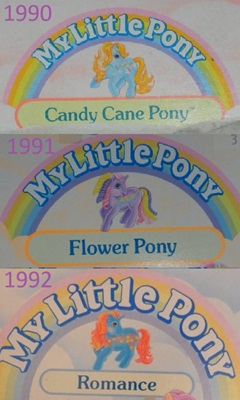 Poster Ponies for the 1990s
UK cards, 1990-1992
A pony from the year's selection featured under the rainbow on
every card - in 1990 it was Mainsail, in 1991 it was Rainbow Rider,
and in 1992, Tuneful.
Each set also had a 'key character' who was illustrated on the
front and back of each card in that set, irrespective of the
character. From 1990 until 1992, pony sets or assortments featured
on card backs as photographs, not as drawings.
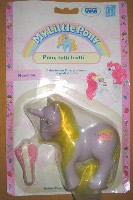 Blackberry Pie Mint on Card (Italian card)
featuring Mainsail under the rainbow and Cherry
Treats as 'set representative'.
Image from SoSilver
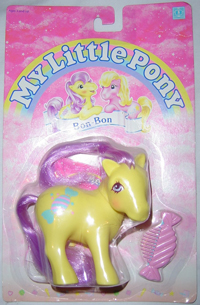 1993 card style change
"Bon Bon"
Image from Dollhands
A New My Little Pony TV Show: My Little Pony Tales
The 1990s is also perhaps best known in some ways for the second
animated series associated with Generation One. This was the "My
Little Pony Tales" series, which starred seven female ponies and followed
their adventures in life, love and at school. It was a much less
fantastical and more slice of life style of story, quite different
from what had gone before. Some people have tried to refer to it
as "Generation Two", because of these differences. This comparison
is basically a nonsense, however. The television series only
became an integral part of My Little Pony in Generation 4 (almost
20 years after My Little Pony Tales was aired). Generation Two is
also a separate iteration, produced from 1997-2003, and the ponies
belonging to this release are entirely different in style and
character. Generation Two had no animation of its own, which has
maybe fed the confusion as well among less knowledgeable fans of
the early series. In any case, there is no doubt that My
Little Pony Tales belongs to Generation One.
Whether the My Little Pony Tales cartoon was produced to be aired
in Europe or not is a matter for debate among fans - but
inclusions such as the UK name for the Glowing Magic(al) ponies and the
inclusion of football, rather than a more American-centric sport
like American Football or baseball, has led to speculation that it
was always intended for the European market.
Although Generation One officially ended in
the UK in 1994, ponies could still be found through clearance in
the subsequent years, and were occasionally found and sold at
market stalls in plain packaging or packages with a grey rainbow
logo stapled to the bag. In spite of this, the gap between
Generation One and Generation Two (in the UK, 3 years, in North
America, 5 years) is the longest time that there has been no
release of My Little Pony since the original release of the line
in 1982.