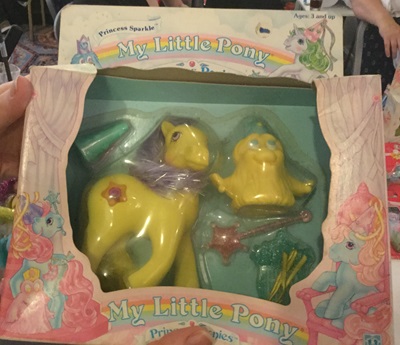
The end of the line in the UK did not automatically mean
ponies stopped being sold over here. Stores often had excess
stock, and this continued to be available in pockets around
the country for some time after 1994. I found a Bed and Crib
Set in box in ToysRUs in around 2000, which is the latest year
I've heard of a G1 item still being on a store shelf. A lot of
Hasbro's own reserve stock ended up at a store in London, from
which we obtained several ponies between 1996 and 1998. Some
little stores even still had stock - my sister and her friend
picked up
Rollerskates
and
Great
Hair Ponies in a tiny toy store in Aberystwyth at some
point around 1996.
The majority of ponies found in the UK after 1994, however,
came at carboot sales, market stalls, and other second hand
outlets. In the time immediately after the end of production,
My Little Pony toys saturated the second hand market. Most
ranged from around 20p to £1 in price, and it was possible to
pick up new ponies more or less every week - sometimes you
could find as many as 20 in one go.
The Internet and Beyond
The online Pony Community began in around 1996, with My Little
Pony Trading Post and the Dream Valley ID site. From a time
when taking a photo meant actually getting it developed (or
putting a pony directly in a scanner), and when paying ebay
fees involved sending $USD in cash across the atlantic, the
last thirty years have witnessed a huge amount of change in
how collecting goes on.
When I joined in 1997-8, the Trading Post was still just an
advertisment board, and most of the community discussion
happened on the pony newsgroups, Ponypeople and Dream Valley
mailing lists. Most ebay auctions did not have pictures; most
traders had to guess at what they were getting if a name was
not included. The internet was littered with mythical ponies,
rumoured variations, and a lot of contradictory information
about what was sold where.
By the turn of the milennium, however, the Trading Post had
become a fully functional forum and trading hub. This screen
capture from the wayback captures one of its later iterations
from 2003 - although the original page was in black and pink.
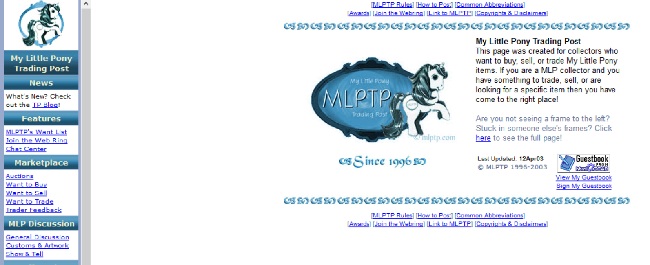 My Little Pony Trading Post (circa 2003)
(Image from the Wayback Machine)
A second pony forum, the My Little Pony Arena, also began in
the early 2000s, and these two forums formed the backbone of
the community for more than a decade.
Art has always been a strong factor in My Little Pony fandom,
and adoptables and small graphics also appeared on people's
websites. The Pony Name Registry was a place where people
could record their individual 'online handles', to prevent
someone else using it - many people used actual pony names
back then, hence why mine is Taffeta.
These days, most G1 sites are centred around collecting and
information, but back then, there were many sites dedicated
not just to collections, but extensive fanfiction, and other
creative media. A fan newsletter, My Little Pony Monthly,
containing material contributed by various collectors, ran
from 1997 until around 2006.
The Ring of Rainbows, begun and hosted by Dream Valley,
connected fansite to fansite. Sites ranged from ID information
and restoration/care to art, fanfiction, and more.
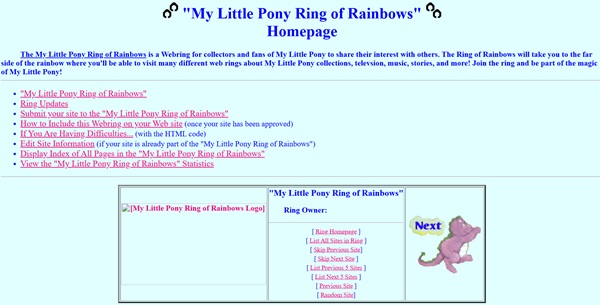 "The Ring of Rainbows" homepage, circa 2001
"The Ring of Rainbows will take you to the far side
of the rainbow, where you'll be able to visit many
different web rings about My Little Pony collections,
televisions, music, stories, and more!"
(Originally from Dream Valley, sourced from Wayback)
Early internet pony sites were usually basic coded free sites
uploaded on hosts like Tripod or Angelfire, with ads aplenty.
Many predated the existence of pretty stylesheets and CSS
coding. Tables and garish backgrounds were the order of the
day.
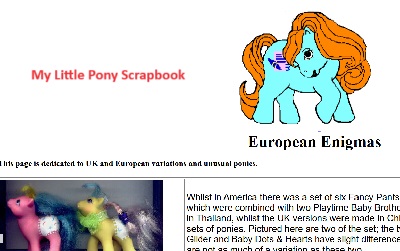 My Little Pony Scrapbook, circa 1999-2000
Tables and basic HTML - ponies in the scanner!
In around 2000 or 2001, the My Little Pony Community
designated August 2nd "International Pony Day." As the below
screengrab from my old site demonstrates, this was shared
around websites and often involved online activities. This
trend has long since died out, but the date was determined by
a community vote. August 2nd was chosen because, in American
dating, it is written as 8/2, and My Little Pony began in
America in 1982.
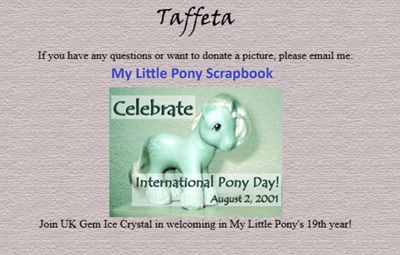 Celebrating International Pony Day, 2001
My Little Pony Scrapbook, circa 2001
(from Wayback Machine)
(As has been mentioned elsewhere on this website, Hasbro
marked the tenth anniversary of My Little Pony in 1992 - the
idea that My Little Pony actually began in 1983 is a more
modern, if anachronistic, assertion).
Most of this side of the community has been lost in technology
upgrades and real life changes. But this does not change the
fact that the original My Little Pony fandom was as much
caught up in character and imagination as it was collecting.
For this reason, I have tried to include pony characters and
concepts on individual pages, as well as facts and dates, as a
nod to that element of our past.
Despite the technological challenges that faced the original
pony community, it flourished through the late 1990s. By the
turn of the millennium, it had become more diverse, and today,
it spans the whole globe. More new collectors of Generation
One join the online community each month, proving that the
appeal is still there.
The original My Little Pony ended in 1995, but its spirit has
lived on, both through later iterations, and through the
collecting fandom. In 2018, Basic Fun, under licence from
Hasbro, began producing replicas of some of the early, popular
characters. Though originally a three year project, the retro
reproduction releases were still continuing into 2024,
indicating their success. In 2023, Basic Fun produced the
Celestial Ponies, still under license from Hasbro, releasing
the first 'new' Generation 1 ponies in almost three decades.
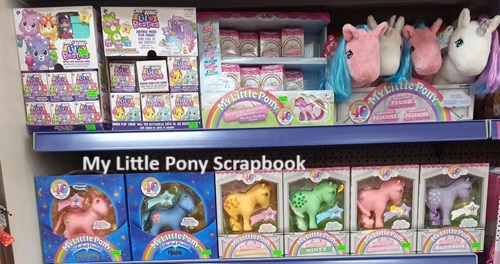 My Little Pony 40th anniversary retro products (Blind
boxes, plushes, Celestials and Collector Ponies) on sale
in Putney, South London
My Little Pony 40th anniversary retro products (Blind
boxes, plushes, Celestials and Collector Ponies) on sale
in Putney, South London
April 2024
Behind the scenes of that release was an intensive campaign
and petition from older generation fans, to bring this
unproduced design to life. In 2024, plush versions of Medley,
Applejack and Twilight - characters never made into plushes in
the eighties - were also put on sale. At time of writing,
Basic Fun have released four 'Totally Rad' reinterpretations
of existing G1 ponies, as well as an exclusive in conjunction
with the Stranger Things Netflix drama series.
Generation 1-themed merchandise also continues to be sold
extensively in stores all over the world.
Despite the challenges faced over the last thirty years since
the end of the line, it's clear that Generation 1 is here to
stay.