"Variant" Ponies
And their quirks
(...And I do mean quirks)
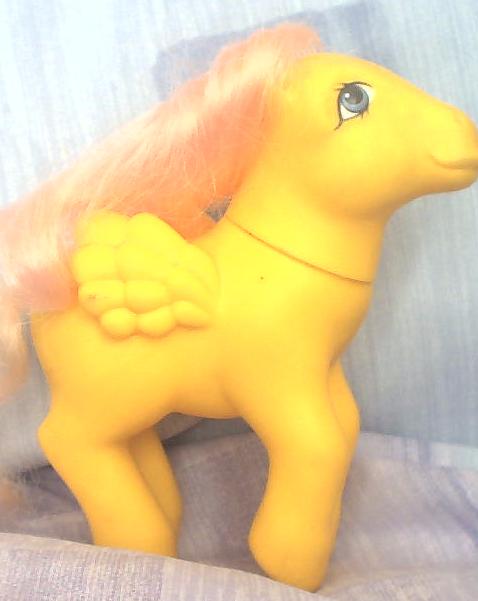
"Bobbie", after whom all Bobbies have since
been named
- An end of line makeshift variant found in the UK
"Bobbie", after whom all Bobbies have since
been named
- An end of line makeshift variant found in the UK
| search engine by freefind | advanced |
As you can see, these are pretty broad categories. They're also
influenced by regional bias. For example, to a person in North
America, Wedding Bells Confetti
would be a "European Variant", because she is sold in a
different pose. But to someone growing up in the UK, we might
say that the walking pose version of Confetti
is a "US variant", because it wasn't sold here. This kind of use
for the word variant is thus unhelpful, and it is much better to
refer to these as different versions of the same pony, rather
than as 'variants'. The same applies for ponies that are made in
China when the original version was made in Hong Kong. While it
could be counted as a 'variant', China and Hong Kong account for
most My Little Pony manufacture. So these are really 'versions',
rather than 'variants'.
Ponies that are made in a country other than Hong Kong or China
are also normal release in some countries, especially in Europe.
Ponies made in Spain and Italy are quite common in those places.
However, it has become generally accepted in the community to
refer to those as 'variants', or "Nirvana" ponies. The term
"Nirvana" was originally coined by the My Little Pony Arena, and
was chosen because of the implication that to obtain one such
variant would be to reach 'nirvana' in terms of collecting
goals. The name stuck, and so 'Nirvana' is also a commonly used
term in the community to talk about variations.
...But not here.
The term Nirvana is sometimes used erroneously to describe
ponies not sold in the USA. This is entirely incorrect. Most
ponies sold outside the USA were mainstream ponies. Almost
everything sold in the UK counts as 'mainstream', even if it
wasn't sold in the USA. The main reason there is much less
information about ponies in Europe and the UK on the internet is
because most sites class everything as either US or 'other'. I
don't intend to add to that mess by muddling the term Nirvana
into a UK centric ID site.
Moreover, Nirvana is a very broad term which has come to mean
anything from a pony made in Spain to a prototype or production
model. Ponies made in Italy, Spain etc are often well merged
into the mainstream releases in those places, however, and are
quite different in production from other licensed variants such
as those made by Estrela in Brazil or El Greco in Greece, etc.
And prototypes and production versions are another level
completely.
The Scrapbook was the first site to include variant ponies on
its pages, albeit in a very limited form. In those days, the
term Nirvana did not yet exist, and it was easier to classify
the ponies based on where they were made. I prefer to still do
it like this, but since I no longer have a large section on
variants, I think this page is enough to give a taste of some of
the diverse production out there.
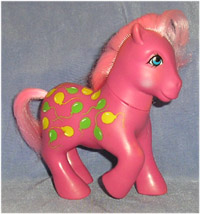
Brazil (Up Up & Away)
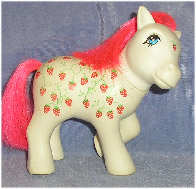
Spain (Strawberry Fair)
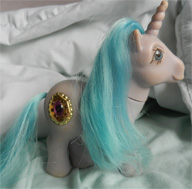
Mexico (Prince Sapphire)
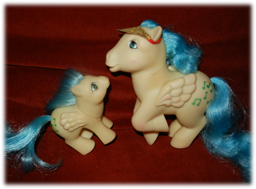
Peru (Medley and Baby Medley)
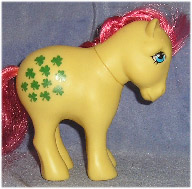
Italy (Minty)
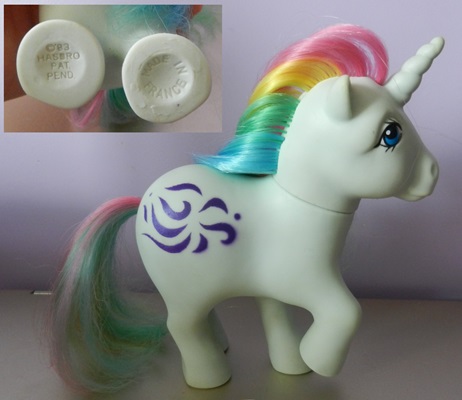
France (Windy)
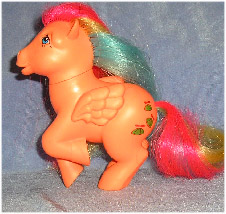
Argentina (Whizzer)
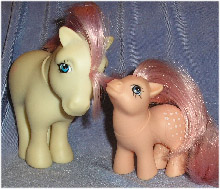
Greece (Bow Tie & Baby Cotton Candy)
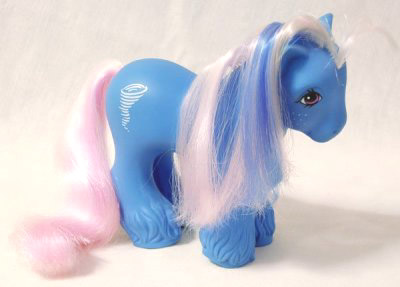
Thailand (Tornado - picture thanks to Lady Ruby)
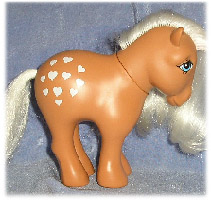
Macau (Jenny / Snuzzle variant)
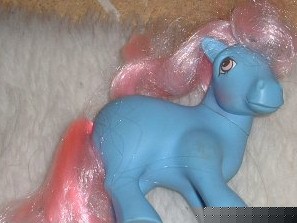
HEX (A symbolless version of
Squeezer without mechanism)
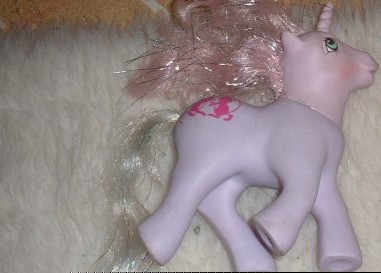
PRINCESS WOOSIE (With the head of Princess Amethyst
rooted with pink hair, and the body off lavender Woosie)
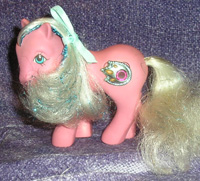
"Rubeta" Hybrid of Taffeta (with aqua tinsel) and Ruby,
with Dawn's symbol.
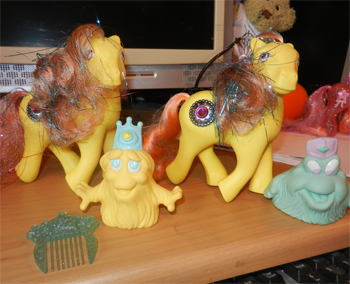
Princess Amber variants, with Sunbeam's symbol, coral
hair andmismatched accessories. One has tinsel in the tail
and the other does not.
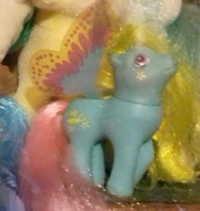
Summer/Windy Wing Hybrid with Buzzer's body, Whirly's
wings and Flurry's tail.