1986
My Little Pony
Rebels with a cause!
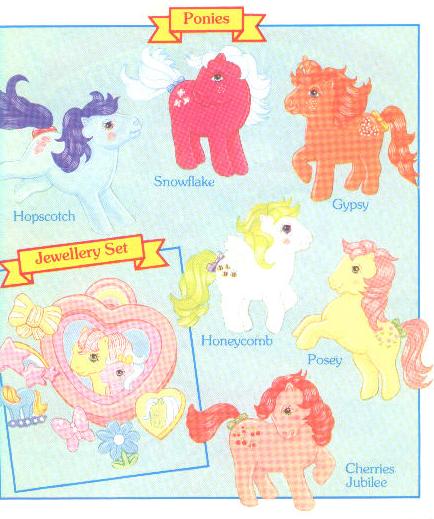
The 1986 assortment, as shown in the UK
insert for 1986
The 1986 assortment, as shown in the UK
insert for 1986
| search engine by freefind | advanced |
You'll notice from the insert image above that Hasbro referred to them here simply as 'ponies'. They are actually missing from my Hasbro list, for some unknown reason, but they were included in Hasbro's 1986 brochure, where they were referred to as "My Little Pony". The text underneath reads as follows:
"The original My Little Pony - phenomenally popular in 1984 and even more successful in 1985 - is joined by four new ponies for fun, fantasy and adventure. The range includes a mix of earthly, pegasus and unicorn ponies, all with straight hair, in a variety of pretty pastel shades and vivid neon colours that girls will simply adore. Each comes with its own bird brush, ribbon and sticker."
This tells us several things about the release.
First, Hasbro intentionally made a mixed set. Secondly, Hasbro
considered this set a continuation of 'My Little Pony' - as
opposed to a set with a gimmick, such as the Rainbow Ponies.
Thirdly, they use the term 'original', which speaks to me
because as a child I referred to all of this kind of pony as
'The Originals', again to distinguish them from ponies with
themes. Finally, there was a conscious decision to make the
hair of all these characters straight, rather than a mix of
straight and curly. I find this fascinating because of how
much emphasis was put on curly hair the previous year, and
because they decided to use Cherries Jubilee and not Tootsie
or Applejack, despite knowing it meant amending her to fit
this convention.
One possible reason for this is that Cherries
Jubilee (and Posey) were still in global
production, albeit as So Soft Ponies. Both Cherries
Jubilee and Posey have darker symbols in the 1986 set, and
these match the symbols used on the So Soft set, in order to
make them visible through the flocking. It is possible that
they thought it easier to amend Cherries Jubilee rather than
try and keep Applejack or Tootsie in production. (A version of
Tootsie did remain in production in some parts of Europe, but
not in the UK)
This set was sent to stores in boxes of 36,
indicating six of each character were probably sent out. This
is a lot of ponies in one box - later Hasbro releases have
smaller distributions. I think this also speaks to the
confidence with which Hasbro UK marketed this set, despite it
being a very unique enterprise.
One interesting factor about this set is how it
breaks the traditions/standards established in North America
surrounding earth ponies and unicorn ponies in particular. In
North America up to this point, there are no regular Earth
ponies with glittery symbols, and every regular release
unicorn pony had a streak of a second colour in her mane.
Hasbro UK ignored both those conventions with this set. Snowflake
is the first (and possibly the only) regular earth pony to
have a glittery symbol, while Gypsy has no second colour streak in
her mane. Snowflake and Gypsy also both have freckles. While
freckles are not unknown for earth ponies (Applejack
and Bow-Tie both
had them), they were unheard of on unicorns. Gypsy is the only
one to feature this trait.
Hopscotch
may seem a lot more traditional in comparison, but it is
notable that her symbol is considerably more detailed/defined
than some other early earth pony symbols. Her hopscotch grid
clearly shows squares and numbers, rather than just shapes.
As for the final new member of the set, Honeycomb,
there are so many questions here that need anwering. Honeycomb
is similar in design to Surprise, suggesting that Hasbro UK
liked this colour scheme and pose. But instead of bringing Surprise
here, they created their own pony, with straight hair and
glittery bees as a symbol. Hasbro themselves seemed confused
at times about Honeycomb, however. The Fact File shows her as
a unicorn, despite being produced a mere year after her
release. She is correctly depicted on her own backcard and
also on Megan
and Sundance's backcard for 1986, so this is probably
just an anomaly, but the story behind her creation remains
mysterious.
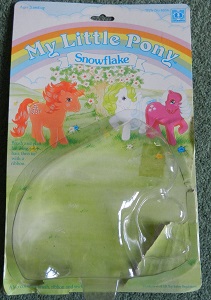
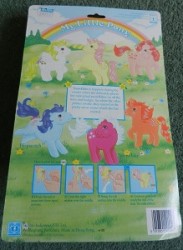
Europe was not a homogenous blob in My Little Pony terms during
the eighties. I know that the UK version of this set (Gypsy,
Honeycomb, Cherries Jubilee, Posey, Snowflake, Hopscotch, made
in Hong Kong) were sold in that form in Hungary and, apparently
in Israel (even though Israel had a lot of US import ponies as
well).
In other parts of western Europe (Hungary is an outlier with
regards to Eastern European countries and Generation 1), a
modified set was made available. Gypsy and Honeycomb were not
sold in most of mainland Europe.
There appear to be eight pony characters involved in this
version of the set. These eight are, in no particular order:
Posey with
magenta tulips (same as UK)
Cherries
Jubilee (Darker symbols, curly hair)
Lickety
Split (Darker symbols, paler pink body)
Hopscotch
(same as UK)
Tootsie
(white)
Snowflake
(same as UK)
Applejack
(Collectors Pose, as sold in UK in 1985)
Bowtie
(Collectors Pose, as sold in UK in 1985
The above only refers to ponies made in Hong Kong. There were
also versions of most of these ponies (again, not Gypsy or
Honeycomb) made in Italy or Spain, and sold in countries like
Germany, the Netherlands, France, Spain, Belgium and probably
others as well. Some of these were sold on an amended 1986 card,
featuring white Tootsie and Lickety Split instead of Honeycomb
and Gypsy.
You can find out more about this set here.